



Inclusion & Special Needs Policy
Table of Content
List of Acronyms
Purpose
Philosophy
IB Standards & Practices Supporting Inclusion
Overview of Inclusive Education at the International Scholars Academy
Three-Tiered System of Support to Meet the Needs of All Students
Identification and Referral Process
Academic Accommodations
IEPs and Learning Support Plans
- Inclusion of Students with IEPs
- Least Restrictive Environment and Inclusion
- Community Resources and School Partnerships
- Confidentiality and Student Records
Differentiation and Teacher Collaboration
Transition from Special Education to General Education
Inclusion Policy Review
Persons involved in Drafting the Policy
Bibliography
List of Acronyms
ADA – Americans with Disabilities Act ATL - Approaches to Learning
DP – Diploma Program
HIPAA – Health Insurance Portability and Accountability Act IB - International Baccalaureate
IEP – Individualized Education Program ISA – International Scholars Academy
LRE – Least Restrictive Environment
MTSS – Multi-tiered System of Support MYP – Middle Years Program
NWEA MAP - Northwest Evaluation Association Measure of Academic Progress PYP – Primary Years Program
SPIRE – Specialized Program Individualizing Reading Excellence WIDA - World-Class Instructional Design & Assessment
IB Mission Statement
“The International Baccalaureate® aims to develop inquiring, knowledgeable and caring young people who help to create a better and more peaceful world through intercultural understanding and respect. To this end the organization works with schools, governments, and international organizations to develop challenging programmes of international education and rigorous assessment. These programmes encourage students across the world to become active, compassionate, and lifelong learners who understand that other people, with their differences, can also be right.”
Purpose
The purpose of the ISA Inclusion policy is to communicate to all stakeholders the expectations for creating an inclusive educational environment. Our practices are designed to ensure that all students, including students with special needs, are provided with rich and rigorous IB instruction, with the support they need to be successful in the least restrictive environment.
Philosophy
International Scholars Academy (ISA) is seeking to be an International Baccalaureate (IB) World School enrolling students from Kindergarten through Twelfth grade (K-12). The mission of ISA is to serve the needs of diverse learners. In seeking to be an IB World School, our focus is on the access and participation of all students in the IB program, including students with both general and specific learning needs. ISA continually reviews and develops policies and procedures to provide support for the learning and participation of its culturally and linguistically diverse student population, as well as students with language learning, specific learning and/or special education needs. Teachers are supported in the use of differentiated instruction, and in the implementation of accommodations, modifications, and other support that may be needed for students' access and successful participation in the program. We employ collaborative learning communities as a part of our learning structure. It is our goal that all learners reach optimal levels of performance and become global citizens who embody the attributes of the IB learner profile. We believe that all students have the right to learn at high levels, and our mission and vision support the IB philosophy that, “The school community fosters internationally minded people who embody all attributes of the IB learner profile” (ibo.org, 2020).
IB Standards & Practices Supporting Inclusion
ISA, as a school seeking to be an IB World School, is committed to maintaining local and global standards that foster an environment of learning for all. The Academy works to make sure that the following IB standards and practices are implemented.
Student support 1: The school provides relevant human, natural, built, and virtual resources to implement its IB programme(s). (0202-01)
Student support 2: The school identifies and provides appropriate learning support. (0202-02)
Student support 3: The school fosters the social, emotional, and physical well-being of its students and teachers. (0202-03)
Student support 4: The school provides guidance and support that helps students succeed in its IB programme(s) and plan for the next stage of their educational and/or career-related experiences. (0202-04)
Culture 1: The school secures access to an IB education for the broadest possible range
of students. (0301-01) programme(s) for the broadest possible range of students. (0301-01- 0300)
Culture 2: The school implements, communicates, and regularly reviews an inclusion policy that creates cultures which support all students to reach their full potential. (0301-02)
Lifelong learners 6: Students take ownership of their learning by setting challenging goals and pursuing personal inquiries. (0402-06)
Approaches to teaching 5: Teachers remove barriers to learning to enable every student to develop, pursue and achieve challenging personal learning goals. (0403-05)
Rights and Responsibilities
Administrators will:
- Communicate and review expectations of the Inclusion and Special Needs Policy with faculty, staff, and ISA stakeholders
- Monitor and review instructional practices to ensure access and inclusion for all students
- Annually review the Inclusion and Special Needs Policy with all stakeholders
- Provide oversight and guidance, convene the Child Study Team, and take part in meetings regarding student support services (a qualified designee may also be identified to perform these duties)
Teachers will:
- Provide high quality instruction for all students
- Differentiate or personalize instruction based on students’ needs, abilities, and interests.
- Regularly review individual student, class, grade level, and subject area data, from but not limited to, MAP reports, SAT scores, formative and summative assessments, observational and anecdotal records, to make data informed decisions for planning, instruction, and assessment.
- Read, understand, and implement student learning profiles, and/or individualized plans with fidelity.
- Participate in professional development opportunities to remove barriers to learning
- Measure student growth toward individual goals.
- Foster positive relationships with students (check ins during homerooms, advisories, student-conferences).
- Communicate regularly with Child Study Team members, students, and parents
- Support student agency in instructional and assessment practices.
- Work collaboratively with other teachers, administrative, Special Education, Counseling, and other divisions to ensure students’ academic, social, and emotional needs are met.
Students should:
- Actively participate in learning activities
- Self-advocate and take advantage of learning support (such as oral and written guidance from teachers, advisory sessions, counseling, and academic support services)
- Understand their individual learning goals and give feedback about these goals (co- creation, achievability).
- Utilize the ATL Skills (Thinking, Communication, Self-Management, & Research) to support their learning and growth
Parents/Guardians should:
- Actively participate in their student’s progress on their learning goals
- Attend Parent and Student-led conferences
- Attend child study team meetings (as or when needed)
- Read and understand student learning profiles and/or individualized educational plans (IEPs)
- Collaborate with school staff to foster a positive learning environment for students
Guidance Counselor will:
- Advocate for students in need of academic and social supports
- Develop strategies for student success
- Collaborate with teachers, parents, and students on needed student supports
Special Education Coordinator will:
- Observe and assess students referred for Tier 3 services
- Develop Individual Educational Plans (IEPs)
- Collaborate with parents and teachers, parents, and students, and school teams as needed about needed student supports
Overview of Inclusive Education – International Scholars Academy
International Scholars Academy is an inclusive educational institution for students in grades K-12 that aims to address the diverse needs of our students. Our students are culturally and linguistically diverse. To meet the needs of all learners, ISA employs a multi-tiered system of support.
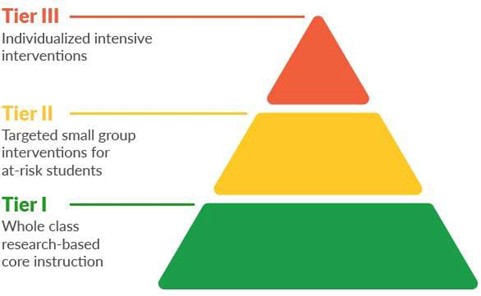
Students at each level, including students with English Language Learning needs, benefit from a collaborative approach. Staff work collaboratively to meet students’ learning, behavioral and developmental needs. The diagram below illustrates the inclusive support model used by ISA.
Three-Tiered System of Support to Meet the Needs of All Students
Tier 1
All students participate in universal screening and core, research-based, high quality, differentiated instruction. Tier 1 instruction aims to meet the needs of a minimum of 80% of learners in the classroom. As such, a part of high quality and high-fidelity core instruction requires that teachers work in consultation with their team leaders and administrators to address learning and behavioral needs within the classroom. Teachers use proven methods that are related to reading, language, mathematics, content area instruction, and consider social- emotional developmental level of students to optimize student access, participation, and progress. Specialists and other related staff may be engaged at Tier 1 to ensure high quality
classroom instruction, fidelity of methods, and to ensure that an appropriate level of scaffolding is provided to all students. By so doing, all students are instructed according to their diverse needs to advance their academic, behavioral, and social/emotional functioning.
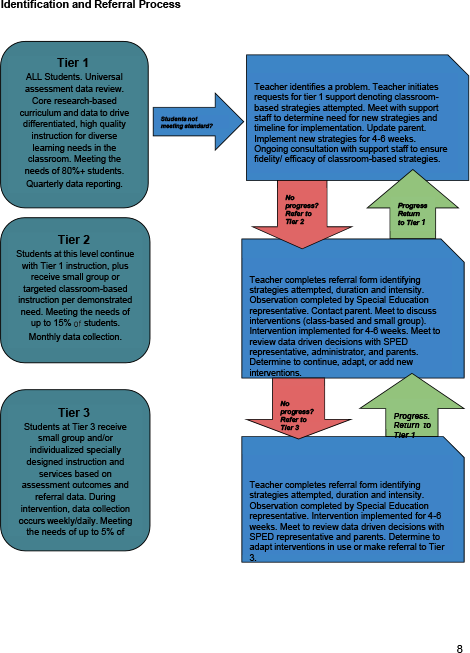
Students who do not meet curriculum-based standards and/or behavioral expectations are provided supports within the classroom first, and staff meet regularly with specialists and/or administrators to determine how to implement relevant supports or to improve their own instructional methods to promote fidelity in instruction. Students participate actively in Tier 1 instruction, with supports and/or accommodations they require for success, for at least 4- 6 weeks before other options are considered.
Communication with parents, who are considered active partners in their child’s education, is a key element in this first tier. Teachers remain in regular communication with parents about their child’s progress, at least quarterly. Additional contacts may be made by staff to celebrate achievements, or to discuss ways in which a student may be supported academically, behaviorally, or in their socio-emotional development. Should a student not make expected progress, teachers update parents on instructional or other strategies attempted and the outcome(s). Parents or teachers may submit a request for consultation with an administrator to discuss the need to initiate a child study team meeting. A pre-referral form will be completed, outlining the problem, strategies that have been attempted, and the outcomes. A classroom observation may be conducted by a specialist or an administrator/designee before a meeting date is set.
Tier 2
A student requiring supports beyond Tier 1 continues to demonstrate difficulty in the classroom, despite scaffolds and differentiation from the teacher. If performance, behavior, or socio- emotional functioning is a concern and supports provided at Tier 1 are not enough to allow the student to show progress, the teacher completes a referral form requesting a child study team meeting and identifying strategies attempted, duration and intensity. A classroom observation may be conducted by a specialist or an administrator/designee before a meeting date is set.
Teachers, specialist(s), an administrator/designee, and parents form the child study team, and will meet to discuss the exact nature of the problem, whether the student requires additional supports beyond those already implemented, and the nature and duration of any proposed new interventions. This meeting will occur within 14 days of the request. A Tier 2 plan will be developed by the team detailing the problem, prior strategies attempted, the outcome of said attempts, and the recommendation of the team for additional small group or individual supports that target the specific needs of the student. The agreed upon plan will be implemented for 4-6 weeks in duration, however, the teacher may find it necessary to consult with any member of the team to ascertain progress every two weeks. Progress monitoring at this level will occur at least monthly, where the child study team will meet to review progress data and use the data to drive a determination to continue the intervention, change the intervention, add a new intervention, or end the intervention. Once a student has shown progress through baseline measures for a specified intervention, the student may return to Tier 1 instruction exclusively, but this decision must be made by the child study team and must be data driven.
Note that the goal of Tier 2 interventions is to meet the needs of 15-20% of students who may require additional supports beyond the classroom. Students are expected to continue to participate in classroom-based opportunities/ core instruction. Tier 2 interventions are meant to complement, not replace Tier 1 instruction, even in cases where a pull-out model is used.
Should a student not make expected progress at Tier 2, a referral to Tier 3 will be made by the child study team at a progress monitoring meeting. The team’s referral to Tier 3 will be communicated to the psychologist on staff to initiate a process that will result in an assessment of the child.
Tier 3
The Tier 3 process includes more intensive, often individualized interventions to meet the needs of a small number of students, (typically fewer than 5%) whose needs cannot solely be met in the preceding tiers.
The Special Education Department staff at ISA is actively involved at Tier 3 with the purpose of promoting inclusion by providing in class support taught by both a general education teacher and a special education teacher where appropriate. All students are expected to participate in general education classes whenever possible with appropriate modifications, accommodations, resources, and supplementary aids. Students with more significant challenges in academic, behavioral, or socio-emotional areas may receive specialized instruction in special education classes specifically designed to address identified needs. Our special education department works in close collaboration with school faculty and parents, informing the school community of the educational rights and safeguards of our students. Parental or guardian knowledge about their children is actively sought and considered when planning and evaluating special education services so that parents and guardians are empowered as partners in the educational process.
Identification and Referral Process
Academic Accommodations
At ISA any student who may need to receive academic accommodation or specialized plans will be referred to the special education department to determine arrangements for accommodations. The Academy as an independent private school offers specialized instruction in English and Math through a push-in/or pull-out model in small group settings or one-on-one based on the needs of the students. For all other subjects, students with individualized special education support plans or disabilities will receive environmental support through instruction in or outside of class, needs based assessments, and/or additional instructional accommodations based on their needs.
IEPs, Learning Support Plans
Students who are being considered for specialized instruction due to determined learning needs must either provide official and appropriate documentation to the school or go through an internal eligibility process to determine the level of intervention required for them to have access to and show progress within the curriculum. In the case of a newly identified student, the special education team will conduct an evaluation to determine eligibility. During meetings with the student’s team, an individualized plan is created to accommodate student needs once a thorough process of evaluation, information and data gathering, and assessment has concluded. The Individual Education Plan (IEP) details the present level of performance, and goals and any required strategies based on demonstrated disability or demonstrated specialized learning needs in academics, behavioral, and social-emotional areas. The IEP is placed on file in the Special Education Department and will be shared with the student, family, and those involved in implementing the documented plan. The special education department strives to support the academic success of all students by understanding individual learning needs and styles. All students are expected to participate in general education classes whenever possible with appropriate modifications, accommodations, resources, and supplementary aids. Our aim is to promote inclusion by providing in class support taught by both a general education teacher and a special education teacher where appropriate. Students with more significant challenges in academic or behavioral areas may receive specialized instruction in special education classes specifically designed to address these needs.
The special education department works in close collaboration with school faculty and parents, informing the school community of the educational rights and safeguards of our students.
Parental or guardian knowledge about their children is actively sought and considered when planning and evaluating special education services so that parents and guardians are empowered as partners in the educational process.
Inclusion of Students with IEPs
The special education staff collaborates and problem-solves with general education (K-12) teachers utilizing co-teaching and consultation strategies to provide the highest quality of differentiated instruction possible. In the inclusion model, all special education students are included in general education classes (with very few exceptions where students may receive special one-on-one instruction, or small group instruction – pull out). General education
teachers and/or special education teachers or learning support teachers collaborate on lesson planning all school year. The special education coordinator collaborates and consults with general education teachers and special education teachers on an ongoing basis through monthly meetings to guide instruction of students with special needs toward successful achievement of curriculum standards. Although the inclusion model is advantageous for most students, there are instances where students’ academic or behavioral needs are best met through an alternative setting using small group instruction.
All students are encouraged to participate in the curricular and extra-curricular offerings at ISA as offered through the IB Primary Years Program, IB Middle Years Program and IB Diploma Programs at ISA. All students participate in the full range of IB offerings. In the IB Diploma program for grades 11 and 12 students may either pursue the full IB Diploma while other students may participate in DP courses toward earning at least two DP course certificates.
Least Restrictive Environments (LRE) & Inclusion
ISA students who receive specialized instruction participate in the least restrictive environment (LRE) to the extent possible. This means that students spend as much time as possible with peers who do not receive special education. The intent of LRE is to make sure that students who receive special education are included in the general education classroom as often as possible. The special education department and those on the IEP team decide in consultation with parents, teachers, and administration which LRE is best suited for each student (Morin, 2020).
Community Resources & School Partnerships
Students with severe needs that are outside of the current school capabilities are referred to seek out resources and programs in the Washington D.C., Metro Area that will help to meet students’ needs in the Herndon VA & Northern Virginia US Metro area or beyond. International Scholars Academy collaborates with its neighboring public schools (Fairfax County and Loudoun County) where students need further evaluations and testing. Furthermore, ISA accepts third party therapy sessions to be conducted (on campus, or virtually) during the student’s academic day as part of their IEP or Learning Support Plan.
Confidentiality & Student Records
Maintaining privacy and confidentiality of student psychoeducational data and records is one of the utmost importance for the school. ISA takes extensive measures for the protection of confidential information they have acquired. In keeping with ADA and HIPAA all student records are secured and only permitted individuals can access and use confidential material.
Assessment
Assessment is vital for evaluating teaching and learning. Assessment allows for self-reflection and peer review, which supports all learners in gaining independence and becoming advocates for their own learning. In grade level meetings, teachers analyze student progress on assessments and reflect on best practices to move students towards proficiency. All students are assessed with either PYP/MYP/DP criteria depending on the age and grade level of the
student: however, accommodations are made for students with special academic needs. Students’ learning needs are also determined through data analysis from NWEA Measure of Academic Progress Tests (MAP), Diagnostic Reading Assessments (DRA), SPIRE, WIDA as well as other psychoeducational assessments offered at ISA such as cognitive assessments, achievement assessment scales, executive functioning scales, dyslexia screening scales, and classroom observations.
Inclusion for IB Coursework and Assessments
Should students need or require accommodations for IB assessment, course work or examinations, such as the MYP Personal Project or DP exams, a child study team may be convened to determine the accommodations necessary in compliance with IB requirements. The IB Coordinators will ensure accommodations are in place for students and communicated to those involved and implemented to meet students’ needs.
Differentiation
At ISA we are dedicated to the well-being and educational success of every child. Through this dedication, the academic and social-emotional needs of each learner are addressed.
Differentiated instructional strategies are integrated into the designed/planned, delivered, and assessed curriculum. Additionally, collaborative efforts among faculty and special educators are used to reflect on the effectiveness of differentiated instructional strategies and plans.
Assignments and assessments are modified as needed, so that all students can demonstrate progress in learning. Modifications may include elimination or extension of learning materials. Ongoing professional development and collaborative planning time is provided to staff members to ensure that differentiation remains a focus during teaching, learning, and assessing.
Transition from Special Education to General Education
Transition from special education to general education and beyond includes the following: testing, background information on students, data reviews, and present levels of academic and functional performance and progress. At the high school level ISA’s Special Education Department considers plans for post-secondary transitions for grades 9-12 students into potential careers, internships, and college and universities. Students’ current testing information, background information, and the present levels of academic and functional performance are evaluated for each student who may receive special education and/or for those who may have an IEP.
Planning, Meeting Time, & Collaboration in the School Community
According to IB Standard C 1:6. “Collaborative planning and reflection incorporates differentiation for students’ learning needs and styles.” At ISA, Special Education teachers support staff, counselor(s), relevant instructors with identifying and using strategies that align with content and with learning needs that students demonstrate. The Special Education Coordinator meets with mainstream instructional staff monthly for professional development and discuss key strategies. Special education staff co-plan lessons with mainstream instructional staff to meet the needs of at-risk students. Each student’s individual learning plans (IEPs) are updated regularly in a collaboration effort to reflect the student’s ongoing needs and goals and
to monitor growth and progress. IBMYP and Diploma Program (middle school and high school) students with an IEP have an assigned case manager. In the Elementary/PYP the Special Education coordinator in collaboration with the homeroom teacher serves as the case manager for elementary students. Case managers coordinate with the at-risk student's team of teachers to align services and to streamline communication with all parties involved including parents.
Inclusion Policy Review
This inclusion policy will be reviewed annually by IB faculty, counselors, coordinators, and the pedagogical leadership team. We will also share the document with the ISA Special Education department and new faculty and staff at the beginning of each year. All ISA stakeholders will have access to the Inclusion Policy via the ISA website toward continuous annual policy reviews and updates.
Persons Involved in Drafting the ISA Inclusion and Special Needs Policy
IB Coordinators (DP, MYP, PYP) Special Education Coordinator
Consultant for Tiered System of Support Planning English as an Additional Language Teachers
Principals
Special Education Teacher
References
Morin, A. (2020, October 22). Least restrictive environment (LRE): What you need to know. Retrieved March 21, 2021, from https://www.understood.org/en/school-learning/specialservices/special-educationbasics/least-restrictive-environment-lre-what-you-need-to-know.